
Table of Contents
- What Actually Drives Paint Protection Film Installation Cost
- PPF Coverage Packages: From Partial Front to Full Body Wrap
- Why Paint Correction Before PPF Changes the Total Price
- How Long Does PPF Installation Take and Why Labor Matters
- DIY vs. Professional PPF Installation: The Real Cost Comparison
- PPF vs. Ceramic Coating: Which Protection Is Worth Your Budget?
- Long-Term ROI: Resale Value and Warranty Coverage
- Frequently Asked Questions
Last Updated: September 12, 2026
What Actually Drives Paint Protection Film Installation Cost
Paint protection film installation cost comes down to four variables: film grade, vehicle size and surface complexity, coverage package, and installer skill. Two quotes for the same car can differ by thousands of dollars, and the gap rarely comes down to the film itself.
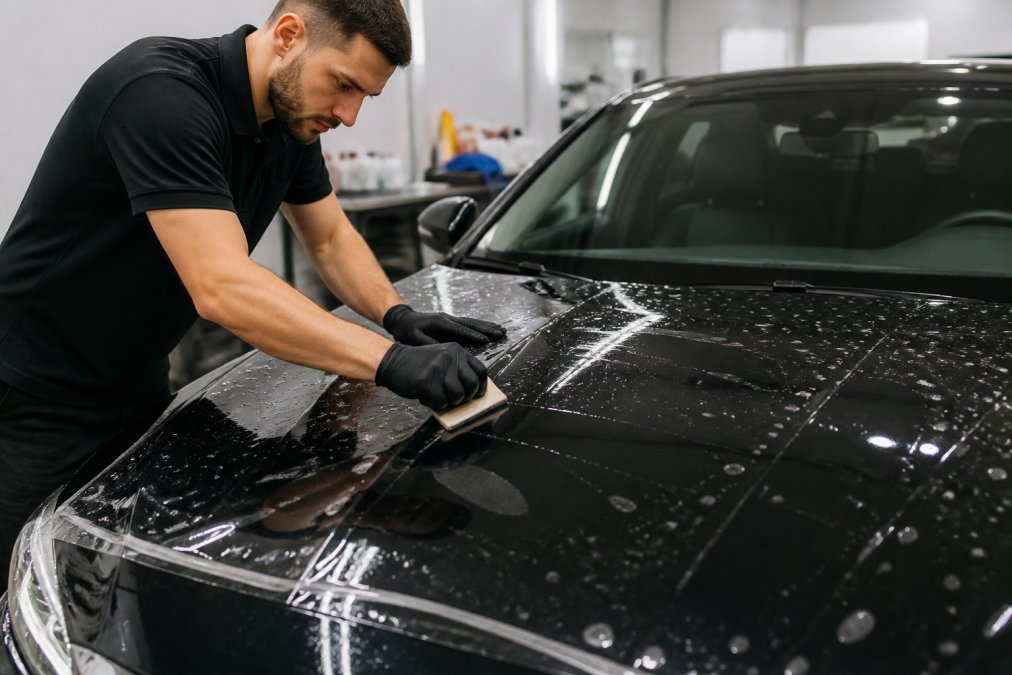
The film is usually the smaller line item; labor, surface prep, and installer experience account for most of the spread. Comparing quotes on price alone is a mistake: a low bid often means thinner film, rushed prep, or exposed edges.
Film Grade and Technology Tiers
Paint protection film is a thermoplastic urethane sheet applied to painted surfaces to absorb rock chips, scratches, and UV damage (xpel.com). Not all urethane is equal: entry-level films run thinner with shorter warranties, while premium films such as XPEL use a self-healing top coat, hydrophobic coating, and UV resistance.
Film thickness, measured in mil, is the clearest signal of grade. Thicker films resist impact better but conform less easily around curves, pushing labor up.
Vehicle Size and Surface Complexity
Square footage drives material cost, but complexity drives labor. Mirrors, door handles, sensor cutouts, and panel gaps all add time. Pre-cut kits trade precision for speed; custom installation from bulk film takes longer but fits tighter.
PPF Coverage Packages: From Partial Front to Full Body Wrap
Coverage packages are the single biggest lever on total price. The more painted surface you protect, the more material and labor the job requires, and the difference between partial front and full body wrap is not incremental. It’s a different project.
| Coverage Package | Panels Covered | Typical Installed Range | Best For |
|---|---|---|---|
| Partial front | Hood strip (18-24 in), fenders, mirrors | $600-$1,200 | Budget-conscious daily drivers |
| Full front | Full hood, fenders, bumper, mirrors | $1,800-$3,000 | Highway commuters, lease returns |
| Full body wrap | Every painted panel | $5,000-$9,000 | Show cars, long-term ownership |
Pricing depends on film grade, vehicle complexity, and the extent of paint correction needed. Treat any numbers as a sanity check, not a fixed price.
Partial Front vs. Full Front Coverage
Partial front coverage protects the leading edge of the hood and the front bumper, the areas that take the most rock chip protection. Full front extends the film across the entire hood, both fenders, the mirrors, and the full bumper, costing meaningfully more because it uses several times the film and requires edge wrapping around panel seams. City drivers can settle for partial front; highway commuters or long-term owners should choose full front.
The jump from partial to full front is usually the largest single step in the pricing ladder. A partial front job might use 15-20 square feet of film; a full front on the same car can use 60-80 square feet (xpel.com). Material scales with square footage, but labor scales faster because bumpers and fenders carry the tightest curves and most cutouts.
Cost Breakdown by Vehicle Type
Vehicle size and surface complexity move the same package up or down by hundreds of dollars. A compact coupe has fewer panels and gentler curves than a full-size SUV with a sculpted front end, and every mirror, sensor cutout, and panel gap adds time.
| Vehicle Type | Partial Front | Full Front | Full Body |
|---|---|---|---|
| Compact sedan / coupe | $600-$900 | $1,800-$2,400 | $5,000-$6,500 |
| Midsize sedan / crossover | $700-$1,000 | $2,000-$2,600 | $5,500-$7,000 |
| Full-size SUV / truck | $900-$1,200 | $2,400-$3,000 | $6,500-$9,000 |
| Sports car / exotic | $1,000-$1,400 | $2,600-$3,400 | $7,500-$10,000+ |
On a Range Rover or Tesla Model X, expect a substantial complexity premium; on a Miata or Civic, the same package lands near the bottom of the range. Complexity, not brand, sets the labor line.
Ask the shop to quote partial front, full front, and full body on your exact year, make, and model. A shop that quotes from a generic price sheet instead of your VIN is guessing at your panel count.
What a Standard Installation Package Should Include
Before comparing two quotes, confirm they cover the same scope. A legitimate full front quote typically includes:
- Film material sized to your specific panels (pre-cut or custom)
- Decontamination wash and clay bar treatment
- Panel wipe and surface prep
- Edge wrapping around panel seams where accessible
- Post-install inspection and bubble check
- A written warranty card tied to the film manufacturer
Quotes that skip decontamination, edge wrapping, or warranty paperwork aren’t cheaper versions of the same job, they’re a lesser job, and that’s where the price gap usually lives.
Why Paint Correction Before PPF Changes the Total Price
Paint correction before PPF is not optional on a used or swirled vehicle. Film locks in whatever is underneath it, so swirl marks, water spots, or light scratches get sealed under the film permanently.
Skipping correction to save money shows up years later, when the film is removed and the paint underneath looks worse than the panels beside it. Correction adds a line to the estimate but protects resale value. On a new car it may be a light decontamination wash and quick polish; on a daily driver with three years of wear, it can be a multi-stage job.
Skipping paint correction on a swirled car means the film permanently seals those defects. When the film is eventually removed, the protected panels will look noticeably worse than the unprotected ones, which hurts resale value.
How Long Does PPF Installation Take and Why Labor Matters
How long does PPF installation take? A partial front job typically takes one day, full front one to two days, and a full body wrap three to five days, sometimes longer on a complex vehicle (xpel.com). That timeline is why labor dominates the estimate.
Labor costs reflect more than hours. A skilled installer works in a dust-controlled bay, uses proper slip solution and squeegee technique, and stretches film without distorting the top coat. Cheap installations cut corners on environment and technique, exactly where bubbles, lifting edges, and premature yellowing come from. Installer skill is the hardest variable to price and the most expensive to get wrong.
Ask any installer how many years they’ve been applying film and whether they work in a dedicated, dust-controlled bay. A clean environment and a steady hand matter more than the brand of film on the box.
DIY vs. Professional PPF Installation: The Real Cost Comparison
DIY paint protection film looks cheaper on paper and almost never is. Pre-cut kits are widely available, and the film itself is the smallest part of a professional quote. The catch is everything else: surface prep, slip solution ratios, squeegee pressure, edge wrapping, and fixing mistakes without wasting film.
The useful version is the actual math, because hidden costs turn a $400 kit into a $1,500 weekend.
The Hidden Cost Stack of a DIY Install
A pre-cut partial front kit for a midsize sedan typically runs $150-$400 depending on film grade. The full cost includes:
- Tools you probably don’t own. A quality squeegee set, slip solution concentrate, a heat gun or torch for edge setting, nitrile gloves, lint-free towels, and a spray bottle add $80-$200. A cheap heat gun that scorches film costs more in ruined panels than a proper one costs upfront.
- Waste from failed panels. A first-time installer typically ruins at least one panel learning the technique. On a pre-cut kit, a ruined panel often means reordering the whole kit, not one piece, because the pieces are cut as a set. Budget one full replacement kit, or roughly double your material line.
- Surface prep you can’t fake. Clay bar, panel wipe, and a dust-controlled space. A garage with a running lawn mower next door is not a dust-controlled bay, and trapped dust under film is permanent.
- Your time. A professional full front job runs one to two days. A first-timer commonly spends a full weekend, sometimes two, and the result is rarely edge-wrapped to the same standard.
- Removal and redo. If the DIY job lifts, bubbles, or traps dust, removing it and paying a shop to redo it usually costs more than the original professional quote. Removal alone adds labor hours before the new install starts.
Add those lines and a DIY kit frequently lands at a higher true cost, with a worse result than a professional full front. The savings only appear if nothing goes wrong, and on a curved panel, something usually does.
When DIY Actually Makes Sense
The one scenario where DIY is defensible is a small, flat, low-visibility panel on a car you don’t care about: a door cup guard, trunk lip strip, or headlight overlay. These panels are forgiving, the film is cheap, and a mistake is invisible. Anything on the hood, bumper, or fenders is a different risk class, those are the panels buyers inspect at resale.
A botched DIY install on a visible panel doesn’t just cost you the kit. It can cost you the paint underneath if removal pulls clear coat, and it can cost you resale value on the exact panels that matter most.
The Professional Labor Line, Itemized
When you pay a shop, you’re buying more than film application. A professional quote bundles:
- Bay time. A dust-controlled, temperature-stable bay is a fixed overhead the shop carries whether or not your car is in it.
- Installer hours. A skilled installer applies film in a fraction of the time a novice does, and the hourly rate reflects years of practice.
- Prep and correction. Decontamination, clay, and any paint correction needed before film goes down.
- Warranty backing. Manufacturer warranties on premium film generally require professional installation and documented aftercare. A DIY install voids that coverage, making the film’s multi-year guarantee worthless on your car.
- Recourse. If a professional install lifts or bubbles within the warranty window, the shop fixes it. If your DIY install fails, you own the problem.
That last point is what most DIY cost comparisons ignore: the professional price includes insurance against your own mistakes, and on a job where one ruined panel can wipe out the savings, that insurance is most of what you’re buying.
DIY PPF is only cheaper if nothing goes wrong. Once you count tools, a replacement kit, your weekend, and the risk of a redo, the professional quote is usually the lower total cost, and it comes with a warranty the DIY job cannot.
PPF vs. Ceramic Coating: Which Protection Is Worth Your Budget?
PPF and ceramic coating solve different problems, and they are not competitors. Paint protection film is a physical urethane barrier that absorbs impact and resists rock chips. Ceramic coating is a liquid polymer that bonds to the paint and adds gloss, hydrophobic behavior, and chemical resistance, but almost no impact resistance.
If your priority is protecting paint from chips and scratches, PPF does the job ceramic coating cannot. If it’s easier washing, deeper gloss, and UV resistance on an already-protected surface, ceramic coating is the finishing layer. Many owners do both: PPF on the high-impact panels, ceramic coating over the film and remaining paint, more upfront, best long-term result.
Long-Term ROI: Resale Value and Warranty Coverage
Paint protection film pays back at resale. A car with intact, chip-free original paint commands more than one with a peppered front end, and buyers of high-end vehicles check for it. Protected panels also hold their finish better, reducing the paint correction needed before a sale.
Warranty coverage is the other half of the ROI calculation. Premium films carry multi-year warranties against yellowing, bubbling, and delamination, but usually require professional installation and documented aftercare. A cheap film with no meaningful warranty is a sunk cost, not an investment. Regional labor rates also shift the math, so always ask what the warranty covers and for how long before you commit.
Paint protection film installation cost is mostly labor and prep, not film. The cheapest quote usually means a thinner film, skipped correction, or a rushed install, all of which cost more to fix later.
Choosing a paint protection film installer on price alone is the fastest way to pay twice. The right shop combines premium film, proper surface preparation, and an installer with years of hands-on experience, and that combination is what actually protects your vehicle’s value. Automobilia Auto Salon has served vehicle protection for 24 years and counting, offering XPEL paint protection film, ceramic coatings, and window tinting alongside amenities no one else can match, including 2025 Tesla courtesy cars so your car never disrupts your schedule. Get a free quote from Automobilia Auto Salon and protect your vehicle’s paint the right way.
Frequently Asked Questions
Is PPF worth paying for?
Paint protection film protects your vehicle’s paint from rock chips, bug splatter, and minor scratches. For luxury and high-performance vehicles, the investment often pays off through preserved resale value and avoided repainting costs. Film quality matters: professional-grade urethane film with self-healing properties lasts longer and resists yellowing better than cheaper alternatives. For daily-driven vehicles in areas with harsh winters or heavy road debris, PPF delivers measurable protection that ceramic coating alone cannot match.
Does PPF installation cost include paint correction?
Not always. Paint correction before PPF is sometimes bundled into the installation quote, but many shops charge it separately. Paint correction removes swirl marks, light scratches, and oxidation so the film adheres to a flawless surface. Skipping this step traps imperfections under the film permanently. When comparing quotes, ask specifically whether paint correction is included and what level of correction the price covers. A detailed, multi-stage correction adds time and labor but ensures the best final result.
What factors cause PPF installation prices to vary?
Film grade, coverage area, vehicle size, paint condition, and installer skill all affect paint protection film installation cost. Higher-tier films with stronger self-healing and hydrophobic coating are a greater investment per square foot. Full body wrap coverage requires more material and labor hours than partial front coverage. Regional labor rates also play a role. Custom installation on complex curves takes longer than pre-cut kits, and vehicles needing paint correction first will see higher totals.
How long will PPF last on a car?
Quality paint protection film typically lasts 5 to 10 years depending on film grade, climate, and aftercare. Professional-grade urethane film with UV resistance and self-healing top coat holds up longer than economy options. Proper installation matters: edges wrapped correctly resist lifting, and warranty coverage often reflects the installer’s confidence in their work. Regular hand washing and avoiding abrasive cleaners extend film life. In harsh climates, film may need replacement sooner regardless of brand.