
Table of Contents
- What Separates High End Car Detailing From a Standard Wash
- Paint Correction and Ceramic Coating Cost in Connecticut
- Paint Protection Film Installation: What the Process Actually Involves
- Auto Detailing Maintenance Packages That Fit Your Driving Habits
- Interior Detailing and Leather Conditioning for Luxury Vehicles
- Winter Detailing and Eco-Friendly Care for High End Vehicles
- Conclusion
- Frequently Asked Questions
Last Updated: September 14, 2026
What Separates High End Car Detailing From a Standard Wash
High end car detailing is a multi-stage process of paint correction, surface decontamination, and protective coating application performed by trained technicians, not a wash-and-wax service. At Automobilia Auto Salon, we’ve spent 24 years explaining the difference to owners who assumed a tunnel wash and a true detail were the same thing. They are not close.
A standard wash removes loose dirt from the surface (Carwash Industry Information). A proper detail removes what’s bonded to it: iron fallout, tar, industrial overspray, and the fine swirl marks that automatic brushes grind into clear coat.
The distinction matters most on vehicles you intend to keep. Swirl marks scatter light and dull the finish long before they cause real damage. Paint correction reverses them. Skipping correction and coating over contaminated paint locks the flaws in permanently.
Here’s the practical breakdown:
| Service Level | What It Removes | Typical Time | Result |
|---|---|---|---|
| Standard wash | Loose dirt, dust | 30-60 min | Clean but unprotected |
| Wash and wax | Dirt plus light surface film | 2-3 hours | Short-term shine |
| Full detail | Bonded contaminants, light defects | 1-2 days | Corrected, sealed finish |
| High end detail | Swirl marks, oxidation, deep defects | 2-5 days | Flawless, coated finish |
The single biggest difference is surface preparation. A high end detail spends most of its labor hours before any protection goes on, because coating over a flawed surface wastes both the product and your money.
Paint Correction and Ceramic Coating Cost in Connecticut
Ceramic coating cost depends on three variables: how much paint correction the vehicle needs, the size and complexity of the body panels, and the durability tier of the coating itself. Most quotes you see online are meaningless without a paint inspection first, because two identical SUVs can need wildly different labor hours depending on how they were washed for the last five years.
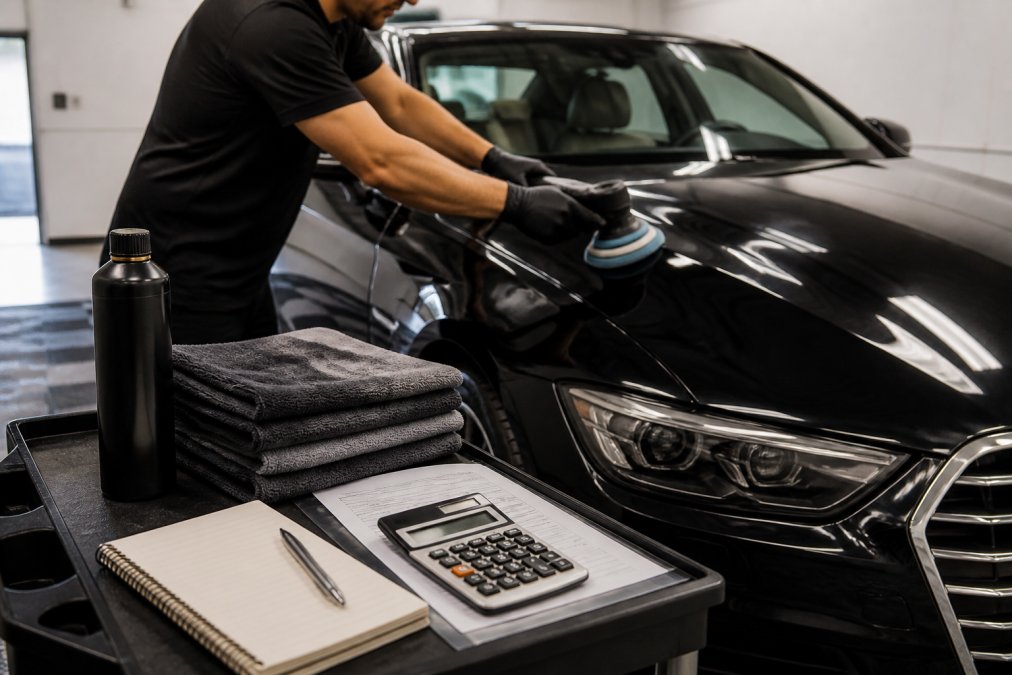
Achieving a flawless finish requires balancing the labor-intensive nature of paint correction with the long-term protection of advanced chemical barriers, which ultimately dictates how ceramic coating costs fluctuate across different vehicle classes.
What Drives Ceramic Coating Cost Up or Down
Paint condition is the largest single factor. A garaged weekend car with light marring might need a single-stage polish. A daily driver with years of automatic car wash exposure can require multi-stage correction, which multiplies labor hours. Correction is where the money goes, the coating itself is often the smaller line item.
Coating tier matters too. Entry-level coatings last a year or two (pubmed.ncbi.nlm.nih.gov). Professional-grade coatings with higher solids content can hold for several years with proper maintenance. Higher solids means a thicker cured film, better chemical resistance, and a longer warranty window.
- Vehicle size and panel count: larger SUVs and trucks take longer to correct and coat
- Paint hardness: some manufacturers use softer clear coats that mar more easily
- Existing damage: deep scratches require wet sanding before polishing
- Coating warranty terms: longer coverage usually requires annual inspections
- Glass, wheels, and trim: coating these surfaces adds labor but extends protection beyond the paint
Wax vs. Sealant vs. Ceramic Coating: What You Are Actually Paying For
This is the comparison most shoppers never get, and it explains why coating quotes run higher than a wax job.
- Carnauba wax is a natural product that sits on top of the clear coat. It delivers a warm gloss and lasts weeks, not months, before it degrades from heat, UV, and detergent. It offers almost no chemical resistance.
- Polymer sealants are synthetic and bond more tightly to the paint, typically lasting several months. They resist UV and water spotting better than wax but still break down under repeated washing and road film.
- Ceramic coatings are liquid polymer (silicon dioxide or graphene-based) products that cure into a semi-permanent film chemically bonded to the clear coat. They deliver the highest hydrophobicity, chemical resistance, and UV stability, and they last years rather than weeks or months when maintained correctly.
The trade-off is preparation. Wax and sealant can go over imperfect paint and hide minor flaws temporarily. A coating locks in whatever is underneath it, which is why correction is non-negotiable before application.
Pricing varies by vehicle and condition, so a blanket figure would be misleading. Automobilia Auto Salon quotes each vehicle after inspecting the paint in person. Request a free quote for your specific car rather than comparing generic numbers.
The most common mistake is shopping coating by price alone. A low quote usually means minimal or no paint correction, which means defects get sealed under the coating and become far more expensive to fix later.
Ask any shop to break the quote into correction hours and coating product. If they can’t, they’re pricing a wash-and-wax job and calling it a coating.
Paint Protection Film Installation: What the Process Actually Involves
Paint protection film installation is the application of a clear urethane film to high-impact areas of the vehicle to absorb rock chips, road debris, and bug etching. It is a physical barrier, not a chemical one, and the installation quality determines whether it performs for years or fails in months.
A proper install follows a defined sequence:
- Decontamination wash to strip all surface debris
- Paint correction so the film sits on a clean, flat surface
- Panel-specific templating or bulk cutting for full coverage
- Wet or dry application depending on film and panel curvature
- Edge wrapping so film edges stay hidden and don’t lift
- Post-install inspection under high-output lighting
- Curing period before washing or coating the film
The difference between a good and bad install shows up at the edges. Film that isn’t wrapped around panel edges collects dirt and peels. Bubbles and lift usually trace back to insufficient surface prep or rushed squeegee work.
Automobilia Auto Salon installs XPEL paint protection film, a brand with a track record that addresses the yellowing and bubbling concerns owners raise about cheaper films. Ask any installer what film brand they use and why.
Ceramic Coating vs. Paint Protection Film: Which Protects What
These two technologies solve different problems, and the honest answer is that they work best together.
- Ceramic coating provides hydrophobic protection, UV resistance, and chemical resistance. It makes washing easier and adds gloss. It does not stop rock chips.
- Paint protection film provides impact resistance against chips, scratches, and road debris. It does not add much gloss on its own and needs coating on top for easy cleaning.
If your concern is stone chips on a highway commute, film comes first. If your concern is water spotting, fading, and wash maintenance, coating comes first. On a high-value vehicle, film on the front end plus coating over the whole car is the standard approach.
Auto Detailing Maintenance Packages That Fit Your Driving Habits
Auto detailing maintenance packages should match how the vehicle is actually used, not how the owner wishes it were used. A daily highway commuter and a garage-kept weekend car need completely different schedules, and the difference compounds over the life of a coating or film.
A Long-Term Maintenance Schedule, Not a One-Time Service
Most shops sell a single detail and move on. The owners who get the most years out of a coating or paint protection film follow a schedule like this:
| Timeframe | What the Vehicle Needs | Why It Matters |
|---|---|---|
| Weeks 1-2 after coating | Cure period, no washing | Coating is still cross-linking; early washing can compromise bonding |
| First wash (week 3-4) | pH-neutral hand wash, two-bucket method | Removes road film without stripping the coating |
| Months 2-6 | Maintenance wash every 4-8 weeks depending on driving | Keeps contaminants from bonding and clogging the coating’s hydrophobic layer |
| Every 6 months | Decontamination wash plus coating booster or topper | Restores slickness and beading; extends coating life |
| Annually | Inspection, iron/fallout removal, coating refresh where needed | Catches embedded contamination and early film lift before it spreads |
| Every 2-4 years | Coating reapplication or film replacement assessment | Coatings degrade; film has a service life even with care |
This is the schedule that separates a coating that lasts two years from one that lasts five. Skipping the six-month decontamination is the single most common reason coatings fail early.
Matching the Package to the Driving Profile
| Driving Profile | Recommended Interval | Focus Areas |
|---|---|---|
| Daily highway commuter | Every 4-6 weeks | Front end, windshield, lower panels |
| City and short trips | Every 6-8 weeks | Full exterior, wheels, interior touch-ups |
| Weekend and garaged | Every 8-12 weeks | Coating maintenance, interior conditioning |
| Winter-driven vehicle | Monthly in season | Underbody, salt removal, paint decontamination |
Ask whether the maintenance wash is a hand wash with pH-neutral soap and dedicated wash media. A maintenance plan that runs your coated car through a brush tunnel undoes the coating’s whole purpose.
What a Maintenance Visit Should Actually Include
A real maintenance detail is not a car wash with a different name. It should include:
- A pH-neutral hand wash with separate wash media for paint, wheels, and lower panels
- A coating-safe drying method, forced air or plush microfiber, never a shared chamois
- A coating booster or topper applied at the recommended interval
- A quick walk-around inspection for film edges, chips, and new contamination
- Interior wipe-down and vacuum on the schedule the cabin actually needs
If a shop can’t tell you which products they use on a coated car and why, the maintenance plan is not protecting your investment.
A coating or film is a system, not a product. The application is day one; the maintenance schedule is what determines whether you get two years or five out of it.
Interior Detailing and Leather Conditioning for Luxury Vehicles
Interior detailing goes well beyond vacuuming. Upholstery cleaning, leather conditioning, stain removal, and odor elimination each require different products, and using the wrong one on luxury materials causes damage that shows up months later.
Leather is the most misunderstood surface in the cabin. Modern coated leather doesn’t absorb conditioner the way older hides did, so heavy conditioning products sit on the surface and attract dust. What leather actually needs is gentle pH-balanced cleaning followed by a light protective layer.
A few rules that hold up in practice:
- Clean leather before conditioning it, always
- Use dedicated leather cleaner, not all-purpose cleaner
- Avoid silicone-heavy dressings on dashboards, which outgas and haze glass
- Treat alcantara and suede differently from leather, with dry methods only
Engine bay cleaning belongs in this conversation too. A careful engine bay detail removes grime and makes leaks visible early, but it must be done with controlled water and covered electronics. Pressure washing an engine bay indiscriminately is how owners end up with electrical faults.
Winter Detailing and Eco-Friendly Care for High End Vehicles
Winter is the season that separates protected vehicles from unprotected ones. Road salt, brine, and freeze-thaw grit do more cumulative damage between November and March than summer driving does all year.
Salt is the primary threat. It accelerates corrosion on underbody components, brake lines, and wheel finishes, and it leaves a film that dulls clear coat (dot.gov). A coated vehicle sheds salt and brine far more easily, which is one of the strongest arguments for ceramic coating in this climate.
Washing frequency matters more than washing intensity in winter. A monthly hand wash that removes accumulated salt does more for long-term condition than a single intensive spring detail. If you can’t wash often, a coating plus regular touchless rinses keeps salt from sitting.
Eco-friendly detailing has moved from a marketing angle to a practical consideration. Waterless and rinseless wash products cut water use dramatically, and biodegradable, phosphate-free soaps keep runoff out of storm drains. For a region with strict stormwater rules, that’s not just good citizenship. It’s often the practical choice.
Detailing standards at the professional level increasingly account for both. Professional-grade shops use controlled wash bays with water reclamation, which handles the runoff issue entirely.
Conclusion
Protecting a high-value vehicle in this climate is a long-term commitment, not a one-time purchase. Paint correction, ceramic coating, paint protection film, and a maintenance schedule that actually fits your driving habits all work together, and skipping any one of them shortens the life of the others.
Automobilia Auto Salon has served vehicle protection for 24 years and is Connecticut’s premier destination for XPEL paint protection film, window tinting, and ceramic coatings. Amenities include 2025 Tesla courtesy cars, so your vehicle can stay in the bay without disrupting your week, plus custom wheels, tires, and paint styling for owners who want the look to match the protection.
Get a free quote from Automobilia Auto Salon and protect your vehicle’s finish with a plan built around how you actually drive.
Frequently Asked Questions
How much does high end car detailing in Connecticut cost?
Pricing depends on vehicle size, paint condition, and the services you choose. Ceramic coating cost rises with the level of paint correction required and the coating’s durability rating, while paint protection film installation is priced by coverage area (partial front vs. full body). Auto detailing maintenance packages are usually quoted monthly or per visit. Automobilia Auto Salon provides free quotes based on your specific vehicle and goals.
Is ceramic coating worth the investment for a luxury car?
For a luxury or high-performance vehicle, ceramic coating adds a hydrophobic layer that makes washing easier and provides UV protection that helps prevent oxidation and fading. It also enhances gloss. The main variable is preparation: without proper paint correction and surface preparation, the coating locks in swirl marks instead of hiding them. On a well-prepped finish, a professional-grade coating can last several years with proper maintenance.
How often should I get my car professionally detailed?
Most luxury vehicles benefit from a full detail every three to four months, with hand washes in between. If you drive through Connecticut winters, schedule a decontamination wash and undercarriage rinse after the last road salt application of the season. Vehicles with ceramic coating or PPF still need periodic maintenance washes to keep the protection layer clean and performing as intended.
Do you offer mobile detailing or courtesy cars for Tesla owners?
Automobilia Auto Salon offers 2025 Tesla courtesy cars so your vehicle doesn’t sit idle during multi-day services like paint protection film installation or full coating packages. Availability is limited, so request one when you book. Mobile detailing is an option for maintenance washes and interior-only services, but paint correction and film installation require a controlled shop environment for proper results.